A work in three parts
John Fridinger
Summer, 2026 — Talent, Oregon
johnfridinger.net
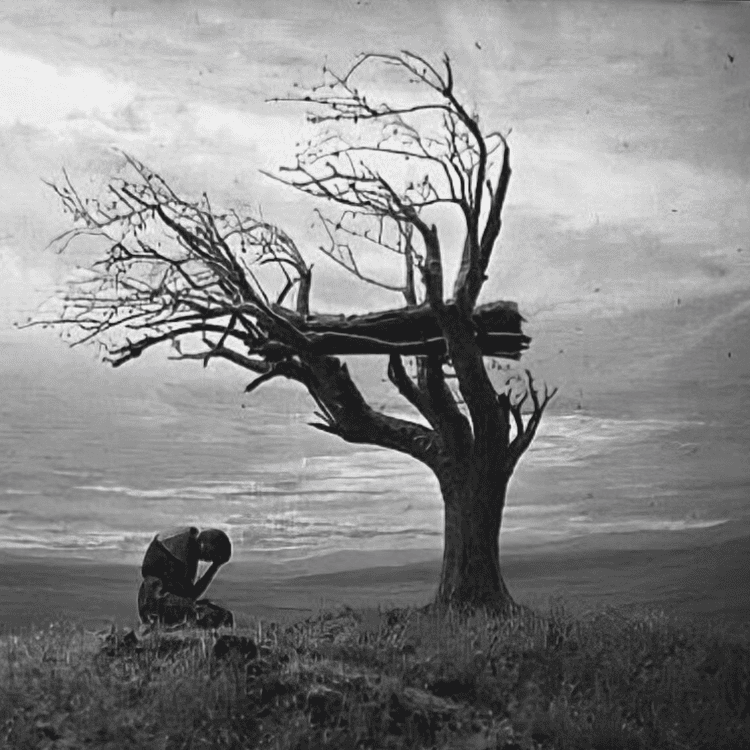
This is a work in three parts. Each one stands alone; together they are completed.
Just as each person stands alone, yet without each other none of us is ever completed.
More so than ever before, in all the many diverse histories of Earth, humans are being called to awaken into this paradox of self-aware existence, a fundamental paradox that can only be lived; never grasped, captured or fully understood.
The three parts of this work attempt something that all the many separate registers of climate science, political analysis, and contemplative understanding have not, to this point, attempted in the same breath: an account of what is actually happening, followed all the way down, without the hedging that has accompanied every major climate report and every serious piece of climate journalism for over thirty years, while the trajectory has continued, unchanged, in the wrong direction.
Endnotes appear at the close of Part One, where specific scientific claims rest on traceable evidence. Parts Two and Three operate on different ground — the kind of knowing that comes from long observation of how power actually moves, and from an awareness that runs deeper than what citations can establish. The absence of hedging throughout is not the absence of rigor. It is the refusal to let cautious institutional language substitute for what that same language has always been carefully constructed to avoid saying plainly.
Part One: Climate Change: What the Instruments Are Actually Measuring
In March 2026, the World Meteorological Organization released its annual State of the Climate report. The Guardian covered it. The headline was accurate: Earth’s energy imbalance has reached a record high. The oceans are the hottest in recorded history. The last eleven years were the eleven hottest years ever measured.
All of that is true. None of it is the full truth.
What follows goes all the way to where the data honestly leads — without the institutional grammar of warnings and calls to action that has accompanied every major climate report for thirty years while the trajectory has continued, unaltered, in the wrong direction.
The surface temperature that humans experience — the heat of the day, the warmth of the ocean at the shore, the number that appears in the headline — represents approximately one percent of the excess energy now accumulating in the Earth system. One percent.
The warming humans have felt, that has already produced the droughts and the fires and the floods and the crop failures and the displaced millions — that is the one percent. Ninety-nine parts more are stored at ever-increasing rates in the oceans, the land, the ice.
And the models that predicted this — that have been the basis of every climate negotiation, every national commitment, every headline about what we must do before it is too late — are themselves underestimating what is happening. By how much, and why, scientists cannot yet fully explain. The gap between what the models project and what the instruments record has been widening. The instruments are ahead of the predictions. Reality is running faster than the science that describes it.
This is the ground we are standing on. Not the ground the official story describes.
Here is what the instruments are actually measuring, followed all the way down.
The Ocean Is Not a Buffer. It Is a Clock.
More than ninety percent of that excess energy is absorbed by the oceans.1 This has been reported as reassuring — the ocean is protecting us, buying time. It is neither. It is the system recording what we have done, storing it, and preparing to return it.
The rate of ocean warming has more than doubled over the past two decades compared with the previous forty-five years.2 That acceleration is not a trend approaching a new equilibrium. It is a trend in the process of breaking the systems that depend on relative stability — systems that took millions of years to develop and that the last ten thousand years of human civilization were built around and within.
The ocean does several things that are now being simultaneously disrupted. It absorbs heat. It absorbs carbon — roughly thirty percent of all human CO2 emissions since industrialization.3 It produces oxygen — between fifty and eighty percent of the oxygen in every breath drawn by every living thing on this planet — through the photosynthesis of marine phytoplankton, organisms invisible to the naked eye that form the base of virtually every ocean food chain and drive the biological pump that carries carbon from the surface into the deep.4
Each of these functions is being degraded. Not independently. Together, interactively, each degradation accelerating the others.
Warmer water holds less dissolved gas — both oxygen and carbon dioxide.5 As the ocean warms, it becomes less capable of absorbing the CO2 that is warming it. The warming also causes stratification: the heated surface water becomes lighter and more buoyant, forming a stable layer that resists mixing with the colder, nutrient-rich water below. That stratification starves the phytoplankton.6 Starved phytoplankton produce less oxygen, sequester less carbon, support less life. The ocean that has been absorbing roughly a third of our emissions and providing over half our oxygen is losing the capacity to do both — because of the emissions it has been absorbing.
This is not a projected risk. A long-term analysis of satellite imagery spanning more than twenty years found a measurable decline in ocean greenness — the chlorophyll signature of phytoplankton — across low and mid-latitude oceans, described by researchers as a clear sign that global warming is already weakening the ocean’s biological carbon pump.7 Phytoplankton numbers have declined by an estimated forty percent since the mid-twentieth century, at an average rate of roughly one percent per year over the six decades studied.8
Forty percent. Of the organisms that produce over half the oxygen on Earth.
This is not in the headline. It is not in the policy conversation. It IS in the data.
The Sinks Are Failing. All of Them. Simultaneously.
Industrial civilization has been running on three great carbon buffers: the oceans, the terrestrial forests, and the soil. All three are degrading at once.
The forests: the Amazon — the largest tropical rainforest on Earth, a system that generates its own rainfall through the moisture its trees transpire — has regions already emitting more carbon than they absorb, due to the compound pressure of deforestation and climate-driven drought.9 The eastern Amazon has crossed this threshold in some seasons. The system that was a net carbon sink is becoming, in parts, a net carbon source. The mechanism that keeps a rainforest a rainforest — trees making rain, rain keeping trees — is being broken at its edges, and broken edges in complex systems do not stay at the edges.
The soil: soils store twice as much carbon as the atmosphere and all vegetation combined — approximately 2,500 petagrams.10 Global soils are projected to flip from carbon sink to carbon source as warming accelerates microbial decomposition of organic matter — releasing between 0.22 and 0.53 petagrams of carbon per year through the end of this century.11 The ground beneath the food system becoming a driver of the crisis that is destroying the food system.
And beneath the soil, in the Arctic permafrost: an estimated 1.7 trillion tons of carbon frozen in organic matter accumulated over tens of thousands of years, now thawing.12 The thaw is not gradual and uniform. It is spatially variable, faster in some regions than models predicted, releasing both CO2 and methane — a greenhouse gas roughly eighty times more potent than CO2 over a twenty-year timeframe.13 This is not a future risk contingent on further emissions. It is happening now, measured, observed, running ahead of the projections.
The Chemical Dimension
The cascade is not only atmospheric. Plastics, now present in every ocean, every food chain, every human bloodstream, every sample of Arctic ice and deep ocean sediment ever tested, are not degrading — they are fragmenting, breaking into microplastics and nanoplastics that cross every biological membrane, including the placental barrier. They are in the tissue of unborn children.20 PFAS compounds — the “forever chemicals” used in cookware, food packaging, firefighting foam, and thousands of industrial processes — have saturated groundwater across entire continents, disrupting endocrine systems, impairing immune function, accumulating in bodies faster than they can be cleared.21 These are not localized industrial accidents. They are the ambient chemical condition of the planet, operating below the threshold of visible catastrophe while reshaping the biology of reproduction and immunity across nearly all species simultaneously.
And this is the chemical condition before the containment fails. The industrial infrastructure of the present civilization — the chemical plants, the waste facilities, the oil pipelines and offshore platforms, the nuclear sites, the agricultural chemical storage, the heavy metal processing — all of it requires functioning institutions, maintained equipment, and continuous human attention to remain contained. As the systems that maintain it degrade — through economic contraction, political breakdown, the cascading failures that follow civilizational stress — the releases will not be orderly. Chernobyl was one facility, one failure, one moment of institutional collapse. The number of sites whose containment depends on the continued functioning of the civilization now under increasing and compounding stress is not one. It is not hundreds. It is tens of thousands, distributed across every continent, holding substances that do not become less dangerous when the people responsible for them are no longer able to show up for work.
This dimension of the emergency does not appear in the climate models. It is not in the diplomatic frameworks. It is barely in the public conversation. It is, nevertheless, already in the water.
The Models Are Wrong in the Direction That Matters
Every projection, every national commitment, every international agreement has been built on models. Those models have been consistently wrong in one direction: they have underestimated. Every major observed climate variable — Arctic ice loss, sea level rise, extreme weather frequency, ocean warming — has tracked at or beyond the upper range of model projections, not the middle or lower range. The models that have been the basis of every policy commitment and every diplomatic negotiation have been, systematically, too conservative. And they remain the basis of every policy commitment and every diplomatic negotiation.
The energy imbalance the WMO now tracks has increased significantly beyond what state-of-the-art climate models projected — particularly between 2010 and 2024, when satellite data shows the balance between heat coming in and heat going out moving well outside modeled ranges.14 Researchers attempting to explain the discrepancy have proposed missing feedback processes, inadequately modeled natural variability, processes in the climate system not yet captured. The honest conclusion: the models are missing something. The instruments keep finding it.
There is one additional factor in this picture that almost never appears in climate coverage. Industrial civilization has been running two simultaneous atmospheric interventions without ever deciding to: pumping greenhouse gases that trap heat, and pumping aerosol pollution — sulfur dioxide, particulates from coal, shipping exhaust — that partially reflects incoming solar radiation back to space. That aerosol layer has been suppressing somewhere between half a degree and one and a half degrees Celsius of warming already in the system — the consequence of greenhouse gas concentrations now present in the atmosphere — but currently deferred.15
The scale of that masking became briefly visible in September 2001, when U.S. airspace was grounded for three days following the attacks of that month. Atmospheric scientists analyzing temperature records from automated weather stations across the country found a measurable increase in the daily temperature range during that window — approximately one degree Celsius — larger than any comparable three-day variation in the previous thirty years of records. Without contrails seeding high-altitude cirrus, more solar radiation reached the surface by day and more escaped to space by night.16 Three days. One degree. From contrails alone.
Now hold that against the full picture.
The warming we are living in is not the full warming our atmosphere has already committed to. A gap stands between what is currently experienced and what is already in the system — and that gap will close.
And here is the trap at the heart of it. The aerosol pollution partially masking that committed warming comes from the same combustion generating the greenhouse gases. They are inseparable products of the same industrial activity. Stop the combustion — which is necessary, because that aerosol pollution itself kills an estimated seven million people annually, and because the greenhouse gases it produces are the actual engine of the climate crisis — and the aerosol masking effect diminishes as the particulates clear from the atmosphere within weeks.
The greenhouse gases will remain for centuries. The aerosol veil will not. The gap closes and the suppressed warming emerges — not gradually, but rapidly. Three days of grounded aircraft over the US already demonstrated what that looks like in miniature. As the planetary haze lifts, the solar energy it had been deflecting begins reaching the surface and staying.
There is no clean exit from this. Rapid decarbonization — the path the science requires — carries within it a near-term pulse of additional warming as the veil lifts. The models have not adequately reckoned with this. The policy conversation has barely acknowledged it.
Another atmospheric factor the models have not included arrived in the scientific literature this spring. A study published in Nature Climate Change in May 2026 found that airborne microplastic and nanoplastic particles absorb sunlight and contribute to atmospheric warming at a level equivalent to roughly sixteen percent of the forcing from black carbon — soot particles from combustion, one of the most potent short-lived climate pollutants.20a Over the ocean garbage patches where plastic accumulates most densely, the effect exceeds black carbon locally by nearly fivefold. The models already underestimating the energy imbalance do not account for this. Another process, running in the warming direction, missing from every projection that forms the basis of every policy commitment.
The system is hotter than it feels. And it is approaching thresholds that do not care about the difference.
The Cascade
In October 2025, the Global Tipping Points Report — produced by 160 scientists from 87 institutions in 23 countries — identified warm-water coral reefs as the first Earth system tipping point to have been crossed.17 Crossed, not approached. Passed.
A tipping point in a complex system is a threshold beyond which the system’s own internal dynamics drive it toward a new state, independent of the external pressure that pushed it to the threshold. The coral reefs are dying not merely because the water is too warm today, but because the feedback dynamics of bleaching, death, structural collapse, and ecosystem unraveling now proceed on their own momentum. The reefs as they existed are committed to loss. They are not the only system that has crossed into this territory.
The Atlantic Meridional Overturning Circulation — the ocean conveyor belt that moderates European and North Atlantic climate and drives the rainfall patterns that feed billions — is now projected to slow by 42 to 58 percent by 2100, a level researchers describe as almost certain to end in collapse. A collapse would push Europe into deep freeze, accelerate sea level rise along the U.S. East Coast, and produce prolonged droughts across swaths of Africa and South Asia. The tipping point where collapse becomes inevitable may be crossed by mid-century — within the lifetime of most people alive today.17a
The same report identified up to eight Earth system tipping points reachable below 2°C of warming.18 2024 was the first year in recorded history to exceed 1.5°C above pre-industrial levels, reaching 1.55°C. 2025 averaged 1.43°C — a temporary La Niña cooling that changes nothing about the trajectory. The 1.5°C threshold is not coming. It has arrived. The political commitments currently on the table — even those being honored, which most are not — drive the trajectory past 2°C well before 2100. That is not a future risk. It is the destination already chosen, by the commitments already made, in full knowledge of where they lead.
What is arriving has no geological precedent outside of mass extinction events. The carbon now accumulating in the atmosphere in decades took natural processes millions of years to cycle. The living systems being disrupted — the reefs, the forests, the ice, the phytoplankton, the soil — evolved within stable conditions that no longer exist and will not return on any human timescale.
Parts of the polar ice sheets may already have crossed tipping points that commit the world to several meters of sea level rise — an unfolding that plays out over centuries, but whose early stages are already here. Global mean sea level has risen roughly eight inches since 1900, with the pace accelerating sharply: the rate of rise in the last decade is approximately three times the rate of the first half of the twentieth century.19 Another foot is projected along U.S. coastlines by 2050 — within the lifetime of most people reading this. By 2100, on the trajectory we are currently on, projections for the U.S. reach several feet, with higher-end scenarios approaching seven feet or more. The immediate consequences — storm surge reaching further inland, coastal flooding becoming permanent rather than episodic, saltwater intrusion into aquifers and farmland — are not coming. They are already here, worsening with each year’s additional melt.
And the tipping points interact. Ice loss changes albedo, which accelerates warming, which accelerates permafrost thaw, which releases methane, which accelerates warming, which accelerates ocean stratification, which starves phytoplankton, which reduces carbon sequestration, which increases atmospheric CO2, which accelerates warming. These are not parallel processes. They are a network with threshold behavior. Crossing one node alters the probability and timeline of crossing connected nodes.
And the losses accumulate below the threshold of what any single human generation is able to perceive as loss.
Here is a dimension of this that the data cannot fully capture. Every generation inherits a baseline — a sense of what the living world is supposed to look like, sound like, feel like. Each generation’s baseline is already degraded from the one before, and that degradation is accepted as the natural state of things. The windscreen no longer covered in insects on a summer night, the way it was when you were a child. The silence where there was birdsong. The bare hillside that was once forest, accepted now as landscape. Scientists call this generational amnesia — each generation experiencing profound loss while perceiving only what currently exists as the new normal. What we mourn, we can only mourn if we remember. What has already been erased leaves no one to miss it.
The science has a word for what happens when a network of interacting systems with threshold behavior begins crossing those thresholds in sequence. It does not use that word in its reports. It uses “cascading impacts” and “compound risks” and “unprecedented challenges.”
The word is: irreversible.
This Is Not a Natural Disaster
What has been described here — the failing sinks, the activating cascades, the gap between suppressed and committed warming, the models running behind the instruments — is not a natural disaster in any sense that phrase has previously carried. Natural disasters happen to civilizations. This one is being generated by one.
The carbon in the atmosphere was put there by decisions — millions of them, aggregated across a century and a half of industrial activity, shaped at every scale by choices about what to burn, what to build, what to count as cost and what to externalize as consequence. The feedback loops now running largely independent of human intervention were set in motion by human intervention. The systems failing simultaneously were stressed simultaneously, by the same industrial logic operating across every sector and every continent at once.
This means the physical reality described in this piece has authors. It has a structure of decision-making behind it. It has beneficiaries — people and institutions for whom the industrial activity that produced these concentrations generated extraordinary wealth, and who have known for decades, in many cases, what that activity was doing to the systems that support life.
That is the territory of Part Two.
Endnotes — Part One
1 World Meteorological Organization, State of the Global Climate 2025 (March 2026). wmo.int — Oceans absorb approximately 90% of excess energy in the climate system.
2 Ibid. — Ocean warming rate has more than doubled over the past two decades compared to the previous 45-year average.
3 Scripps Institution of Oceanography, FAQ: Ocean Deoxygenation. scripps.ucsd.edu — Oceans have absorbed approximately 30% of human CO2 emissions since industrialization.
4 Petrovskii et al., A two-timescale model of plankton-oxygen dynamics, PMC (2024). — Marine phytoplankton contribute 50–80% of atmospheric oxygen production.
5 Scripps Institution of Oceanography, FAQ: Ocean Deoxygenation. scripps.ucsd.edu — Warm surface layers prevent oxygen mixing; warming reduces dissolved gas capacity.
6 Long, Di et al., reported in Inside Climate News, October 2025. insideclimatenews.org — Stratification blocks nutrient upwelling, starving phytoplankton across low and mid-latitude oceans.
7 Ibid. — 20-year satellite analysis documents decline in ocean greenness and phytoplankton bloom frequency; described as clear sign of weakening biological carbon pump.
8 Worm, Boris et al., Nature (2010), reported in Science/AAAS. — Phytoplankton estimated to have declined approximately 40% since 1950 at roughly 1% per year.
9 Global Tipping Points Report 2025, University of Exeter and international partners (October 2025). global-tipping-points.org — Amazon at risk of widespread dieback below 2°C; eastern regions already net carbon emitters seasonally.
10 Sanderman et al., reported in GSA Today and MIT Climate Portal. — Soils store twice as much carbon as atmosphere and all vegetation combined; approximately 2,500 petagrams total.
11 Wang et al., Nature Communications (2024). — Constrained Earth system models project global soils switching from carbon sink to source under continued warming.
12 Multiple sources including WMO State of Climate 2025 and Arctic monitoring data. — Siberian permafrost alone estimated to contain approximately 1.7 trillion tons of stored carbon.
13 IPCC and supporting literature. — Methane approximately 80 times more potent than CO2 over 20-year timeframe.
14 Yukimoto et al., Geophysical Research Letters (February 2026), reported in Live Science (April 2026). — 15 state-of-the-art climate models compared against satellite data confirm models underestimate energy absorption, particularly 2010–2024.
15 Multiple sources on aerosol masking effect. — Estimated suppression of 0.5°C–1.5°C of committed warming currently offset by industrial aerosol emissions.
16 Travis, David J. et al., Nature (2002). — Analysis of automated weather station data during post-9/11 grounding found approximately 1°C increase in diurnal temperature range, attributed to absence of contrail cirrus.
17 Global Tipping Points Report 2025. global-tipping-points.org — Coral reefs identified as first Earth system tipping point crossed; current warming has exceeded coral thermal tipping point of approximately 1.2°C.
17a Portmann et al., Science Advances (April 2026), reported in The Guardian and CNN (April 15–16, 2026). — New research finds AMOC slowdown of 42–58% by 2100, 60% stronger than average model estimates; researchers describe this level as almost certain to end in collapse. Elipot et al., Science Advances (April 2026, University of Miami) provided direct observational confirmation of AMOC weakening at four latitudes over two decades.
18 Ritchie et al., Environmental Research Letters (2026), reported in The Ecologist (March 2026). — Up to eight tipping points reachable below 2°C; up to five triggered by small, brief overshoot of 1.5°C.
19 WMO State of the Global Climate 2025; IPCC Sixth Assessment Report (2022); NOAA Sea Level Rise Technical Report (2022). — Global mean sea level has risen approximately 8 inches since 1900; U.S. coastlines projected to see approximately 10–12 inches of additional rise by 2050.
20 Ragusa et al., “Plasticenta: First Evidence of Microplastics in Human Placenta,” Environment International (2021). — Microplastics detected in human placental tissue; subsequent studies confirmed presence in human blood, breast milk, and fetal tissue.
20a Liu, Yu et al., “Atmospheric warming contributions from airborne microplastics and nanoplastics,” Nature Climate Change, vol. 16 (May 2026). — Warming contribution equivalent to 16.2% of black carbon, with regional peaks over ocean garbage patches exceeding black carbon by 4.7-fold.
21 U.S. Geological Survey, “PFAS in U.S. Drinking Water” (2023). usgs.gov — PFAS compounds detected in approximately 45% of U.S. tap water samples; widespread contamination documented across Europe, Asia, and the Arctic.
Part Two: The “Makers” of What Is Happening
Something has shifted in how this moment feels, even for people who have been paying attention for a long time.
It is not simply that the news is bad. Even as the news has been bad. It is that the simultaneity of so many diverse and interacting parts of the news has become impossible to hold. Trade wars and tariffs landing on households already stretched past breaking. Federal agencies gutted or shuttered — the Forest Service, environmental enforcement, the offices that tracked what was happening to the land and water and air. Veterans losing homes by the tens of thousands while the institutions pledged to their care are systematically dismantled. Public lands opened to extraction. Wars burning on multiple continents, each one drawing resources, attention, and the fossil fuel infrastructure that feeds both the conflict and the crisis simultaneously.
And beneath all of it, most of the time, most people: just trying to get through the day. The rent. The medical bill. The school pickup. The second job. The third. The specific exhaustion of living in a system that requires maximum output for minimum stability, that has structured daily survival so completely that there is no bandwidth left for the scale of what is arriving.
This is not incidental. It is the system working as designed.
The mind that is occupied with survival cannot organize. The community fragmented by economic precarity cannot coordinate. The population drowning in manufactured information chaos — a thousand conflicting signals, a new outrage every hour, the algorithmic reward of reaction over reflection — cannot sustain the kind of attention that systemic crisis requires. The confusion is not a bug. It is load-bearing infrastructure.
What follows is an attempt to name the structure underneath the overwhelm. Not to add to the weight of it. To make it legible. Visible. Because the thing that cannot be named cannot be understood, and the thing that cannot be understood cannot be faced, and what cannot be faced will simply continue.
The Ruling Class Has Done Its Math
The people at the apex of the global economy are not ignorant of the data in Part One. They have the same reports. They have better reports — private intelligence, proprietary modeling, scenario planning that does not get published. The science is not hidden from them. This is not a measured fact. It is something known the way certain things are known — through decades of watching how power moves, through the pattern that only becomes visible when you stop waiting for confessions. What the behavior shows is that they have reached a strategic conclusion.
The conclusion is this: the transformation required to prevent civilizational destabilization would dissolve the conditions of their power.
Managed collapse, on the other hand — with adequate security, geographic positioning, food sovereignty, private infrastructure, bunkers already under construction in New Zealand and Montana, and control of the political apparatus — preserves and potentially extends those conditions. The math, from inside that horizon, is not irrational. It is simply operating on a different unit of concern than civilization. The unit is dynasty. The preservation of advantage across generations, within a protected enclave, while the systems that supported everyone else contract.
And here is a piece of that math, rarely named directly, that makes everything that follows legible.
In 1970, Earth Overshoot Day — the date each year when humanity’s consumption exceeds what the planet can regenerate — fell on December 30. Two days from the year’s end. We were nearly living within our means.
In 2025, it fell on July 24. Five months of the year now running on ecological debt, the date advancing every year as what is consumed continues to outpace what can be replenished. The current rate: 1.8 Earths consumed annually. One Earth available.
Recurring estimates in carrying capacity science — the number this planet can support long-term while remaining a living system rather than a depleting one — cluster, at current consumption levels, around two to two and a half billion. The present global population is 8.2 billion. The gap between those numbers is not a projection. It is the present condition, already running.
The ruling class has this arithmetic. Not through the public reports available to anyone — but through private modeling, proprietary scenario planning, the insurance and reinsurance industry risk calculations that have been pricing ecological overshoot into global markets for thirty years, the Pentagon’s classified climate war-gaming that has been running since the 1990s. They have known longer, and in more detail, than anything that has reached public conversation.
What the bunkers are responding to is not uncertainty about whether the crisis is real. It is certainty about what the carrying capacity gap means — and what kind of infrastructure you would need, in place early, to administer the difference between two and a half billion and eight.
That number — two and a half billion — is not from before human civilization. It is from within it. The Earth last held that population around 1935. A world with electricity, medicine, cinema, the New Deal, one world war already behind it. A recognizably modern world. Not a fantasy of return to some pre-human baseline. A world your grandparents lived in, and photographed.
What tripled the population beyond that threshold — synthetic fertilizers, the petrochemical food system, the fossil-fueled Green Revolution — is the same complex of systems now driving the destabilization. And it did not happen accidentally. Industrial capitalism required mass consumers the way mass consumers required industrial capitalism — each manufacturing the other across the same century. The population the ruling class arithmetic is now reckoning with as surplus was the same population their system deliberately cultivated as market. They created the demand. They grew the base. They are now planning around its contraction.
What that math requires, and has always required, is theft. Theft from future generations — the tipping points already crossed, the committed sea level rise, the permafrost carbon already releasing: these are debts placed on futures that had no voice in the transaction, no seat at the table where the calculation was made. And theft from the whole itself — because what privatization has always been, at its root, is the severing of parts from the living whole, and the claiming of them: water rights, mineral rights, the genetic commons, the atmosphere’s capacity to absorb, the soil’s capacity to regenerate. Nature becomes real estate, resources, empires. Each enclosure is a theft from the interdependence that makes life possible. The climate crisis is, among other things, the whole refusing to stay severed. The bill coming due on every transaction that pretended the part could be owned without consequence to the whole.
The abstract has its address.
Watch the behavior, not the statements. Bunker construction in New Zealand and Montana. Private aquifer rights. Vertical farming investments and seed bank acquisitions. The deliberate dismantling of international cooperative frameworks — not out of incompetence but because multilateral institutions are the architecture of collective response, and collective response to climate disruption would necessarily involve redistribution of both responsibility and resource. Security-state expansion. Border militarization framed as sovereignty, functioning as the infrastructure of triage: when the displaced arrive — and they are arriving, and will arrive in far greater numbers — the apparatus is already in place to decide who is inside the wall and who is not.
This is not conspiracy. Conspiracies require secrecy. This is strategy, much of it stated plainly in the venues where the relevant class speaks to itself, rendered invisible to the broader public only by the gap between what is said in those rooms and what is reported as news.
Nor is any of this new in kind. What is new is only the scale. The enclosure of the commons — driving peasants from shared land into a labor market that needed them — was this same calculation made in medieval England. The clearing of indigenous peoples from their land to make way for extraction was this same calculation made across five centuries of colonial expansion. The plantation economy, the company town, the Dust Bowl — extract, externalize the cost, position above the consequence, administer the remainder. The ruling class has been doing its version of this math since the first hierarchies of the early agricultural civilizations decided that surplus grain, held by the few, was power over the many. The climate emergency did not change their logic. It enlarged the theater in which the same logic plays out — from the village commons to the planetary commons, from the local watershed to the global atmosphere. The bunkers are not a new response to a new crisis. They are the manor house at civilizational scale.
Nor is it a unified class acting in concert. Its factions compete, betray each other, form temporary alliances and dissolve them. What holds the pattern together is not coordination but structure — the same logic of enclosure and extraction operating across rival interests.
What holds the competing factions together at the root — beneath their wars with each other over which fraction of the diminishing spoils each will control — is not strategy. It is the shared meta-belief: that the separation is real, that the hierarchy it produces is legitimate, that the right to own and dominate what is beneath them is ordained. By God, by merit, by the market, by nature itself in the social Darwinist version. The specific theology varies. The meta-claim is identical across all of them. And it is that claim — not any particular policy or faction or figure — that this planetary crisis is, finally and physically, in the process of refuting.
The endpoint of the logic, followed all the way: autocrats, warlords, oligarchs, billionaires, patriarchs — left fighting each other over the rubble of an Earth they finally destroyed through millennia of fighting over who would possess, own, and control it. Not a prediction. A trajectory. The same logic that cleared the commons, stripped the forests, bought the legislators, built the bunkers — followed to where it was always going. The math they did was correct about everything except the one variable that determines all the others: that the Earth is not a resource to be divided among the victors. It is the ground every one of them stands on. Including the last one standing.
Fascism as Climate Strategy
Project 2025 was not an aberration. It was the coherent political program of a fraction of the ruling class that had concluded democratic governance cannot manage the coming contractions without producing redistribution they are unwilling to accept.
Read it in that light and it becomes legible. The demolition of the regulatory state. The capture of the judiciary. The installation of loyalists throughout the executive apparatus. The attack on the civil service. The gutting of environmental enforcement specifically. The opening of public lands — the commons, the shared ecological inheritance of every citizen — to extraction by private interests. The closure of agencies that monitor what is happening to that land, that water, that air: not because the monitoring is expensive but because the monitoring produces the evidence that constrains the extraction.
Who gets water when the aquifers drop? Who gets food when the supply chains contract? Who gets healthcare when the heat kills? Who gets shelter when the floods come? These are the actual political questions that the coming decades will answer. Fascism is, at its operational core, a system for ensuring those answers favor the already-powerful — institutionally, legally, militarily. The cruelty is not incidental to the project. It is the point. It establishes, in advance, the hierarchy of who matters when there is not enough.
The veterans losing homes — tens of thousands of them, the warnings explicit and documented, the program shut down anyway — are not a policy failure. They are a demonstration. Of who is expendable. Of what the state will and will not protect. Of how the apparatus works when the resources contract and the hierarchy asserts itself.
And running beneath all of it, the infrastructure of identification and control. The surveillance state has been assembling itself for decades: the expanding databases of biometric and behavioral data, the CCTV networks now joined to facial recognition and AI, the algorithms that cross-reference purchasing and movement and association across billions of lives simultaneously. What was once the capacity of intelligence agencies directed at foreign adversaries is pointed inward now.
The current push completes the architecture. Passport or birth certificate requirements for voting. Proposed federal mandates requiring banks to verify citizenship status for all accounts. The logic is linear and its endpoint is plain: those without the approved credential cannot vote, cannot bank, cannot participate in the formal economy. The undocumented, the elderly who never needed documents, the poor whose papers were lost or never issued, the communities that have historically had reason to avoid state registration — these become, in the language of administered systems, ineligible. In the language of what is actually happening: disposable.
The difference between the two parties is one of candor, not of outcome. The Republican apparatus takes the visible heat. The Democratic apparatus raises objections calibrated not to dismantle the architecture but to negotiate its terms. The surveillance infrastructure, the identification requirements, the databases — these were being built and extended across administrations of both parties, and will continue to be. One party is building the cage openly. The other is quietly ensuring it is well-constructed.
The assault is moving on a thousand fronts simultaneously, and that simultaneity is not chaos. It is coordination. Each rollback, each gutted agency, each transferred public asset reinforces the others. The cancerous advance across every institution simultaneously is not the absence of strategy. It is the strategy.
This did not arrive without preparation. In August 1971, corporate lawyer Lewis Powell — two months from his Supreme Court nomination — wrote a confidential memo to the U.S. Chamber of Commerce that functioned as the blueprint for everything since. What followed was the deliberate construction of the entire institutional apparatus of the modern right — the Heritage Foundation, the Cato Institute, ALEC writing model legislation distributed to state houses across the country, the Federalist Society building the judicial pipeline that eventually produced a Supreme Court supermajority capable of reversing fifty years of settled law in a single term. Not a movement. A machine, assembled over fifty years, patient in ways that democratic politics structurally cannot be. Project 2025 is that machine arriving at its intended destination.
The figure most visibly associated with this moment did not build the machine. He is what the machine looks like when it stops pretending. The vulgarity, the grandiosity, the open contempt for every institutional norm — these are not aberrations from the project. They are its honest face, finally unmasked. He did not corrupt the system. He is the system’s most unguarded self-portrait.
The Tech Eschatology
First they separate from God through belief. Then they replace God with themselves through belief. Then they reinvent themselves and the world as they believe.
The Silicon Valley fraction of the ruling class has developed its own ideological resolution to civilizational crisis, and it deserves direct naming because it is now substantially shaping policy.
It runs roughly: technology will solve this. Specifically, our technology, deployed on our timeline, under our control, at profit. The belief system combines techno-utopianism with a deep Calvinist structure — the elect, the brilliant, the wealthy-because-deserving, will engineer their way through while the rest are sorted by market forces and their own inadequacy. Effective altruism’s utilitarian calculus, longtermism’s willingness to sacrifice present populations for abstract future goods, the rationalist community’s contempt for democratic deliberation — these are not quirky intellectual fashions. They are the ideological superstructure of a class that has concluded it should be making civilization-scale decisions unilaterally.
The Mars project is not eccentricity. It is the logical endpoint of the enclave mentality: if Earth becomes uninhabitable for most, the elect depart. The rest are not their problem. What this ideology cannot metabolize is interdependence. The phytoplankton do not care about net worth. The wet bulb temperature does not make exceptions for genius. The bunker breathes the same compromised atmosphere as everyone else’s lungs, eventually. But “eventually” is doing enormous work in that sentence — enough to sustain the delusion through a human planning horizon, which is all the delusion needs to do.
What the tech eschatology cannot metabolize is not merely interdependence as an abstract value. It is interdependence as the actual operating principle of every living system on Earth. The mycorrhizal network beneath the forest floor does not have a management layer. The watershed does not have an optimization algorithm. The reef does not have a CEO. What makes living systems capable of sustaining themselves through disturbance is not control from above but lateral exchange across diversity — the constant movement of signal and nutrient and adaptation across a web that has no center, no hierarchy, no single point of failure, and no single point of solution.
The tech-management worldview has no answer to this — not because it lacks intelligence, but because the form of intelligence it possesses is precisely the form that cannot see what it cannot control.
The logic does not stop at the bunker or the rocket. Mind uploading — the digitization of consciousness, the transfer of the self into a substrate that does not age, does not sicken, does not depend on a living planet — is the transhumanist project the broader network has funded and publicly endorsed. Leave the planet. Leave the population. Leave the body. Each step the same ontological move, the separation logic carried one degree further toward its absolute conclusion.
One analyst noted the medieval parallel precisely: this retailing of immortality is no different from the Church selling indulgences — salvation available, at considerable cost, to those who can afford it. The rest remain embodied. Remain mortal. Remain subject to the wet bulb temperature, the failed harvest, the rising water.
What this project cannot reach, and will never reach regardless of the capital deployed, is the one thing Part Three moves toward: not the perfection of the separate self but the recognition that the separate self was the confusion from the beginning. What they are attempting to upload is not consciousness — consciousness is the ground and source out of which every self arises and into which it returns, the between that cannot be privatized because it was never owned. What they are uploading is the self’s story about itself. That story can be digitized. It can be preserved indefinitely. It cannot be made alive.
The Patriarchal Thread
The domination of nature and the domination of women are not metaphorically connected. They are structurally identical and historically simultaneous. The enclosure of the commons — the conversion of shared ecological inheritance into private property — and the enclosure of the female body — the conversion of reproductive capacity into a managed resource of patriarchal households and states — are the same civilizational move, carried out in the same centuries, justified by the same ontology of hierarchy and ownership.
The current rollback of reproductive rights, the global resurgence of explicitly patriarchal political projects, the targeting of gender and sexual identity by the same coalition that targets environmental regulation — this is not coincidence. It is the reassertion of the ownership paradigm across all its fronts simultaneously, under pressure. When the system is threatened, it reaches for control. Of bodies. Of land. Of water. Of information. Of the future through the control of reproduction.
The climate crisis lands on women — particularly poor women, particularly women in the Global South — with compounding force. Water collection is women’s labor in most of the world; water scarcity multiplies that burden. Agricultural disruption destroys subsistence farming, which is primarily women’s work. Climate displacement produces conditions in which gender-based violence accelerates. The bodies most exposed to heat, flood, food insecurity, and displacement are the bodies with the least political power to shape the response. The correlation is not accidental. It is the design.
What patriarchy sometimes named “matriarchy” — and feared, suppressed, and sought to control across millennia — is not the mirror image of itself. It is the very Whole it believes it is severed from. The relational, the cyclical, the generative, the commons, the body’s knowing, the living web that precedes every structure built on top of it.
The Whole is not a competing power threatening to dominate in return. It is the ground itself, seen through the eyes of what had cut itself off from it — and therefore experienced, inevitably, as threat, as something to overcome. Ownership became the means: of animals, of slaves, of land, of resources, of objects, of women — eventually hardening into capitalism, colonialism, imperialism, the fully elaborated machinery of a belief in separation that had been deepening across hundreds of generations.
You cannot completely identify with the false belief that you are separate from the whole — and then look upon the whole without fear. The fear is the proof of the severing. The domination is the fear’s response. Here is the true original sin: not disobedience, not sexuality, not knowledge — but this identification with the belief of separation itself, and the world it then had no choice but to produce.
This is why the assault moves simultaneously on every front: on women’s bodies and on the living body of the Earth, on indigenous knowledge and on ecological systems, on the commons of land and water and atmosphere. They are not separate fronts. They are one front. The Whole, in all its aspects, turned into threat and resource and property by the same original move — the move that called itself civilization, and named what it was separating itself from as something to be conquered and owned.
The Religious Accelerant
Christian nationalism in its American form has produced something theologically novel and politically catastrophic: an eschatology that welcomes ecological destruction as confirmation of divine plan. The premillennial dispensationalist framework — in which current events are signs of imminent Rapture, in which the faithful will be removed before the worst arrives — has been absorbed into the Republican base with consequences that are not symbolic but legislative.
Why pass clean water regulation if the end is near and the saved will be spared? Why accept the economic disruption of decarbonization when the timeline of history is in God’s hands? The theology provides moral permission for political passivity on climate at precisely the moment political action is most urgent.
Islamic and Hindu nationalisms operate with different theological content but parallel political logic: the nation, the faith community, the ethnic-religious bloc as the unit of ultimate concern, with universal claims — including the universal claim of a destabilizing atmosphere — subordinated to its survival. Climate response requires coordination across precisely the boundaries that religious nationalism is designed to harden.
Beneath Christian nationalism’s end-times theology, and older than it, runs a second current that does even more direct work for the ruling class calculus: the prosperity gospel. Its premise is simple and its political consequences are vast. Wealth is evidence of God’s favor. Poverty is evidence of its absence. This theology has been stated baldly from pulpits, in megachurches, on television broadcasts reaching tens of millions. It does not merely tolerate inequality. It consecrates it. The billionaire is not just powerful — he is blessed. The dispossessed are not just unfortunate — they are, in this framework, receiving what their spiritual condition has earned. This is not a fringe teaching. It is one of the fastest-growing theological movements on the planet, exported from American evangelicalism into sub-Saharan Africa, Brazil, South Korea, the Philippines — precisely the regions of the Global South that bear the greatest weight of what the North’s accumulation has produced. The theology follows the damage. It arrives in the communities most devastated by the crisis and teaches them that the devastation is their own fault. There is no more efficient mechanism for preempting the outrage that justice would require.
The Media Architecture
Six corporations control the majority of what Americans see, hear, and read. That consolidation is not incidental to media failure on climate. It is the mechanism by which a collapsing reality is rendered manageable and sold back to the public in service of the interests that own the apparatus.
The advertising-based media economy depends on maintaining a consumer psychology — a sense of normalcy, manageable problems, products that will help — that is incompatible with the honest communication of civilizational emergency. You cannot run car advertisements adjacent to content that accurately conveys the stakes of continued combustion. You cannot maintain institutional credibility while reporting that the institutions are inadequate to what is coming.
The Murdoch empire made a strategic decision, sustained over decades, to manufacture and maintain climate denial as a political identity for a significant fraction of the electorate, in multiple countries. This was not editorial judgment. It was a business and political calculation — that a portion of the population could be kept in manufactured doubt, insulating the fossil fuel interests of the class the Murdoch empire serves from the political consequences that accurate information might produce. It worked. It cost decades. Those decades are not recoverable.
Social media did not improve this. It replaced manufactured consensus with manufactured chaos. A fractured information environment in which coordinated disinformation is cheap, attention is the scarce resource, outrage is the engagement driver, and the long-form systemic analysis required to understand interconnected civilizational crisis is structurally disadvantaged at every level.
The result is not stupidity. It is manufactured ignorance at scale — a substantial portion of the population systematically isolated, across decades of deliberate engineering, inside information enclosures that present an entirely different reality from the one the instruments are measuring. Not slightly different. Entirely different. In those enclosures the crisis is not real, its causes are not human, and the political forces most committed to ensuring it continues are portrayed as the people’s defenders against an elite hoax designed to strip them of freedom and prosperity. This is not an accident of algorithm. It is the designed output of investments made by specific interests over specific decades, for the specific purpose of preventing the political consequences that accurate information would produce.
What has followed is something the Murdoch calculation did not fully anticipate but that grows directly from the ground it prepared. Economic stripping and community dismantling, across those same decades, removed from millions of people the actual conditions of belonging — the union hall, the neighborhood, the church that was a community rather than an ideology, the workplace stable enough to know your coworkers’ names.
What replaced those conditions was a screen. And on the screen, a market emerged for the hunger itself. Not for information, not even primarily for outrage, but for the ersatz feeling of family — harvested from the ruins of its absence, and sold back at a markup. The hate is the content. The belonging is the bait.
The second move was subtler and in some ways more damaging. The spaces people fled to — the counterculture, the alternative movements, the wellness communities, the conspiracy-adjacent corners of the internet — were themselves infiltrated, seeded, and redirected. Distrust of institutions is not hard to redirect when you control what feeds it and what it is aimed at. The result is people who correctly sense that something is deeply wrong — and who have been handed maps that lead away from the ruling class and toward its preferred targets. The map feels like awakening because it uses the language and posture of awakening. The counterculture did not escape capture. It became one more terrain in the same war.
The spiritual register was not exempt. The teachers who carried genuine transmission existed alongside, and were progressively outnumbered by, those who allowed the teaching to become the teacher’s identity. The enlightenment brand. The workshop empire. The retreat center as luxury product. The ancient pointing finger turned into a monetized destination — sold back, at considerable markup, to the very people the separation economy had most thoroughly hollowed out. Not liberation from the empire of separation. A spiritually rebranded franchise of it.
The Global South Carries What the North Made
The carbon in the atmosphere was put there overwhelmingly by the industrialized nations — by a century and a half of fossil-fueled accumulation in Europe, North America, and Japan. The consequences fall overwhelmingly on the nations that contributed least: the Sahel, the Horn of Africa, South Asia, the Pacific Island states, Bangladesh, Central America.
This is not irony. It is the continuation of the same imperial logic by other means. Extraction of natural resources from the periphery to fuel accumulation at the center — followed by externalization of the costs of that accumulation back onto the periphery. The agricultural subsidies that flooded African markets with artificially cheap American cotton and grain, undercutting local farmers and restructuring entire rural economies around dependency — these are not separate from the climate story. They are its economic architecture.
And when the populations move — driven by heat, drought, flood, crop failure, the collapse of the conditions of life — they are met at the borders of the nations that created those conditions with walls, with violence, with the legal apparatus of exclusion. The refugee is not the future. The refugee is the present, in numbers that will multiply by orders of magnitude. The political response being constructed for that reality is not cooperation or shared burden. It is fortress. The militarized border as the primary climate adaptation policy of the wealthy nations: keep the consequences outside, let them continue to be the problem of the people already suffering them.
The same centuries that put the carbon there destroyed something else — something that cannot be measured in parts per million.
Of the roughly 7,000 languages spoken on Earth today, more than half are expected to vanish within this century — most of them indigenous languages, each one a distinct architecture of relationship between a people and the living place they evolved within over thousands of years. A language dies, on average, every forty days. Since 1960, twenty-eight entire language families have vanished. A language is not merely a communication system. It is a way of knowing — a particular set of distinctions, a specific grammar of relationship with the land, the seasons, the species, the cycles of the place it grew from. When it goes, what goes with it is not translatable into the language that replaced it.
This erasure has been running in parallel with every other stripping motion named in this piece — the same centuries, the same logic, the same ontological move. The people who knew the watershed — its cycles, its thresholds, its particular requirements — were separated from it, or killed, or their children were taken and their language beaten out of them. What was lost is not recoverable by satellite data or ecological modeling. It lived in relationship, transmitted body to body across generations, and the transmission was cut.
The biodiversity of human cultures is not ornamental. It is, like ecological biodiversity, the resilience of the whole. The same industrial logic that replaced diverse agricultural ecosystems with monocrops replaced diverse human knowing-systems with a single epistemology: the one that treats the world as resource, that measures value in extraction, that has no grammar for reciprocity or limit.
What is arriving now cannot be met by that epistemology alone. The knowledge that could have helped meet it was, in many cases, deliberately destroyed by the same civilization that has created the need for it.
The Machinery of War
War is not a separate thread in this picture. It is woven through every level and degree of it.
The fossil fuel infrastructure and the military apparatus are not parallel systems — they are the same system. The petrodollar architecture — the guarantee that oil is priced in dollars and that dollar-denominated debt is backed by military force — is the load-bearing structure of American global power. The transition away from fossil fuels would dissolve that architecture, redistributing global economic power in ways the current hegemon cannot tolerate.
Climate-driven crop failures in one region produce food price shocks that destabilize governments in another. The Arab Spring had a climate signature — drought, crop failure, bread prices — that the political narrative largely omitted. The Syrian civil war emerged from a five-year drought that collapsed Syrian agriculture before a single shot was fired. These connections are documented. They do not reach the policy conversation with the weight they actually carry.
The costs of war flow downward: energy prices rising, inflation compounding on households already stretched past breaking, the fiscal weight of sustained military operations added to public debt that will constrain every social program for decades. The benefits concentrate upward: defense contractors, oil sector profits rising with every disruption to regional supply.
The loop extends further. The near-closure of the Strait of Hormuz has disrupted roughly half of global urea exports — the nitrogen fertilizer that American row crops require. Since February 2026, nitrogen fertilizer prices have risen more than thirty percent. Farm diesel, another forty-six percent. In a recent survey of more than five thousand farmers, nearly two-thirds reported unable to afford all the fertilizer they need for this planting season. Farm bankruptcies rose forty-six percent in 2025 — the third consecutive year of increase.
The land does not stay empty. Bill Gates is now the largest private farmland owner in the United States. The USDA estimates thirty percent of American farmland is owned by non-farmer landlords. The multi-generational farm family becomes a tenant. The food supply — its soil, its water rights, its seed genetics, its distribution infrastructure — moves toward the same hands already positioned above the waterline in every other dimension of the coming contractions. The war disrupts supply. The disruption stresses farmers at the margin. Bankruptcy produces consolidation. Consolidation transfers the food system to institutional ownership. The enclosure logic, running on the mechanism the war provides.
And war consumes. It consumes fossil fuel — war cannot be made without it. The U.S. military is the largest single institutional emitter of greenhouse gases on the planet. It consumes the materials whose extraction is already stripping what remains of functioning ecosystems. It consumes the political attention and institutional capacity that might otherwise be directed toward the emergency.
The autonomous weapons trajectory is now documented. In January 2026, Hegseth issued a formal directive to make the military “AI-first across all domains.” The budget request for the Defense Autonomous Warfare Group for fiscal 2027: $55 billion. The previous year: $225 million. The question of whether a human being will remain in the decision loop for the most consequential act available to the state has been answered, in the relevant planning documents, by people with the authority to act on the answer.
The Shape of the Whole
Name it plainly.
What is being destroyed is not only the living systems of the planet. The collective human terrain — shared meaning, community bonds, cultural commons, the social fabric that makes collective life possible and worth living — is being strip-mined by the same logic and the same actors.
The enclosure of the commons was always simultaneous: land and community, watershed and neighborhood, forest and shared culture. What gets named as social fragmentation, polarization, the collapse of civic life — these are the human ecosystem failing under the same extractive pressure as the physical one. Different substrate. Identical motion.
A civilization built on the premise of separation — of humans from nature, of men from women, of owners from consequences, of the elect from the rest — has produced a crisis that is the full return of those denied consequences. The atmosphere does not recognize sovereignty. The ocean chemistry does not honor property rights. The wet bulb temperature does not stop at the fortified border.
The political structures now ascending — nationalist, authoritarian, oligarchic, patriarchal, religiously legitimized, fascist — are not equipped to manage this crisis. They are not trying to. They are trying to manage the population through this crisis in ways that preserve existing hierarchies. This is a categorically different project.
Conflating it with climate response is the central confusion of liberal politics. It keeps political energy and institutional faith invested in a system whose actual project is the management of hierarchy through the crisis, not the resolution of it.
The fractures will not be orderly. Food shocks produce political instability produce conflict produce refugee flows produce border violence produce further radicalization — this sequence is already running in multiple regions and will multiply. The people who will bear the weight of it are the same people who always bear the weight: the poor, the displaced, the Southern peoples, the female, the young, the ones for whom daily survival already consumes everything available.
This is not prediction. It is the present tense, in the places that have already arrived there. The rest of the world is on the same trajectory, just at different points along it.
None of this diminishes the people who are fighting inside the existing system — the organizers, the local legislators, the mutual aid networks, the young progressives entering politics with genuine intent. Their work is real. The courage it requires is real. The specific people being protected by that work are real. What is being named here is not their failure but the structure they are fighting inside — a structure that absorbs reform, outlasts administration cycles, and has been consolidating power at a rate that outpaces the resistance it generates.
There is no honest accounting of this that ends with institutional rescue. The institutions are captured, compromised, structurally inadequate, and innately contrary to the scale and speed of what is arriving. What the ruling class has built — the enclave, the wall, the extracted asset, the militarized border — will not hold against what is coming. The phytoplankton do not negotiate. The tipping points do not accept terms.
What arises at the edges and in the depths has never been a managed solution. Every civilizational crisis that eventually gave way to something different gave way not because a sufficiently sophisticated management layer was installed above it, but because something the management layer could not see, could not reach, and could not control was already moving in the places the management layer had no interest in. In the margins. In the cracks. In the soil beneath the pavement and the watershed beneath the boundary line and the human knowing that survived the residential school and the enclosure and the erasure — not intact, not without wound, but alive.
That is not the tech eschatology’s territory. It is not administrable. It does not scale in the way that word is used by people who use it. It is, in the oldest sense of the word, local — particular, placed, relational, embedded in the specific living systems of specific places by specific people over specific generations. The global was always built on top of it. Whatever comes after will be built on top of it again.
A Note on Knowing
There is a form of understanding that names the structure perfectly and changes nothing. It produces the specific paralysis of people who see clearly — the numbing that follows the naming when the scale of what is named exceeds anything the individual can act against directly. This piece is aware of that risk. The point of the accounting is not to add to the weight. The weight is already there, whether named or not. The naming only makes it visible.
But visible to what?
The mind that can hold this analysis is not the instrument that will meet what is coming. It is a necessary instrument. It is not sufficient. The analysis can describe the machinery of separation. It cannot dissolve it.
What meets it is something the machinery cannot reach and has never reached, despite five centuries of dedicated effort: the knowing that was always underneath the analysis, underneath the crisis, underneath the civilization that produced it. Not belief. Not hope. Not optimism about outcomes. Something older and less fragile than any of those.
That is the territory of Part Three.
Part Three: The Ground Beneath
Parts One and Two have followed the data and the political anatomy all the way down — without institutional grammar, without false exits. What they found is what they found. The window for a wholesale different outcome has closed. What set itself in motion is in motion.
What those instruments cannot reach is where Part Three begins.
What Parts One and Two could not name — because physical science and political analysis, however rigorous, stop at a certain depth — is what all the burning is happening within.
“Ground” and “spaciousness” — words that will keep appearing in this piece, that give it its title — are metaphors. As all words, finally, are. Metaphor — language pointing at what it cannot contain — is not a lesser kind of truth. It is the only kind available for what cannot be defined, held, or captured; for what can only be joined. The ground being named here is not a concept or a belief. It points at something you either recognize when you meet it, before it is explained, before any reason is given — or you don’t.
The between that is not between you and something else. The ground itself, wearing the appearance of relationship, of encounter, of the burning world demanding response. And no amount of pointing will manufacture the recognition in someone not yet ready to receive it. Recognition, like germination, happens in its own time.
The ground and the spaciousness that holds this emergency is not the emergency.
That sentence needs to be earned, not merely asserted. It is not meant to comfort. What the reefs were is gone. What the old-growth was is gone or going. What the ice held is releasing. The forms, intricate physical relationships and systems that organized ten thousand years of human civilization — stable climate, predictable seasons, rivers fed by glaciers, nursery reefs for the fish that fed generational billions — these are changing faster than adaptation can follow, and the forms that the after will take are not yet known, and not knowable from here.
The burning is real. The loss is real. The threshold is crossed.
And the ground beneath the burning, the spaciousness that holds all of this, is not burning.
Not in any sense that comforts — not the sense that says: it will be alright, the Earth will recover, the arc bends toward justice. Those are sentences that the data does not support and that this piece has refused since its first paragraph.
In a different sense. The sense that Parts One and Two have been standing on, without naming it.
The separation ontology — nature as resource, owner as separate from consequence, the elect as separate from the rest, civilization as separate from the living systems it extracts from — has always been pretending that parts could be severed from the whole without cost. The crisis is the return of everything that thousands of years of pretense has been squandering. The feedback loops named in Part One are not metaphors for connection. They are connection — the actual, insistent, indifferent reassertion of what was never severed, only acted upon as though it were.
The atmosphere does not recognize sovereignty. The ocean chemistry does not honor property rights. The phytoplankton do not make exceptions for net worth. This is not moral language. It is the description of a system whose interdependence was always the fact, and whose destabilization is the consequence of centuries of pretending otherwise.
This crisis is not the punishment of separation. It is the end of its pretense.
The world as we have made it is what consciousness looks like when it forgets its original nature. What we have been calling the burning is what that forgetting has produced.
The deepest version of this story — older than capitalism, older than empire, older than any of the structures Part Two traced through their most recent fifty-year assembly and five-thousand-year roots — is written in the body.
Human males are born from women. They come through the lineage of the womb. That fact was once understood as sacred — not in the sense of religious performance but in the sense of origin. You came from something. That something was not beneath you. It was what you were, and were always moving back toward.
Something in that understanding was severed. Deliberately, across millennia, in the same movement that enclosed the commons and declared the living world a resource. The enclosure of the female body and the enclosure of nature are not merely parallel. They are the same gesture — the same ontological move, made in the same centuries, justified by the same hierarchy that placed men above women and humans above the rest of creation simultaneously. The womb that was once the origin became property. The forest that was once kin became timber.
The sacred lineage of the womb — the fact that a fetus with ovaries already carries within her the eggs of the next generation, alive inside her grandmother’s body before she herself is born, a thread that runs unbroken through every human being alive — is not a hierarchy. It is an origin. It cannot be owned. It can only be honored or violated.
And the full spectrum of human love and embodiment — what we now name as LGBTQ+ — does not complicate this. It confirms it. The same spiral visible in galaxies, in the double helix, in the turning of seasons. Existence does not organize itself into fixed opposites. It moves, turns, includes.
Hierarchy is not natural. It is an invention. The natural world does not operate by it. Ecosystems do not have a top. Watersheds do not have a boss. The mycorrhizal networks beneath the forest floor do not answer to a CEO. What they are organized by is exchange — the constant, lateral, mutually supporting movement of nutrients and water and signal across the whole. Circular. Multidimensional. Not vertical. Not above. Within.
There is no other — just all these different localizations of the same One, discovering relationship in infinite ways. All of existence is relationship, no real objects, no real things, relationship ever shifting, changing and evolving into higher and higher levels of infinitely diverse, interdependent and interconnected localizations of awareness.
The binary between individual and collective was always false — an invention, built from partial seeing. The part serves the whole; the whole serves every part. This is not ideology. It is the actual operating nature of every living system that has ever sustained itself. And followed all the way down: there are no things. Not finally. Not even individuals or wholes, parts or collectives — for ‘whole’ implies ‘not-whole,’ and both are made of the same cloth. There is only relationship — that tension, that energy, manifesting as every apparent individual, every apparent collective, in infinite evolving possibility. Creation and destruction themselves part of a greater dance that four-dimensional existence can only feel, never finally know.
Existence has always been this. The hierarchy was a story imposed on top of it. Humans are not good or bad by nature. They are human.
What is driving this crisis is not human nature but what humans have come to believe they are — separate, above, and entitled to extract without consequence. That is not nature. It is belief. And our beliefs, unlike natural systems and physics, can be changed. Have always changed. Will change again.
There is, and has always been, a natural tension between the part and the whole. That tension is not the problem. It is the ground and substance of relationship itself — the energy through which diversity moves, change happens, evolution unfolds. The part that plays its unique role fully, faithful to its own nature while remaining in felt awareness of the whole, serves both simultaneously. Opposition is a minor note in that larger music.
The part that loses that felt awareness — that begins to experience the tension as threat, as something to overcome, defeat, possess — has not escaped the whole. It has begun to consume it. What was participating in creation has become an agent of destruction. The behavior of cancer is one name for this. The behavior of empire is another.
What happens when the story of separation is followed to its logical end — when all natural and interdependent friction is removed and the insulating layers of wealth and power and impunity grow thick enough that other people’s reality stops registering as real — is not liberation. It is the acceleration of the pathology. The self that experiences itself as fundamentally apart from others and from consequences is not comfortable in that separateness. It is in existential terror of it. The drive to accumulate, to dominate, to control is not the expression of a self that feels powerful. It is the expression of a self that feels acutely unsafe — and has concluded that enough power, enough wealth, enough enclosure will finally produce the safety that the separate self can never actually feel, because the unsafety is built into the structure of the separate self.
The billionaire in the bunker, the autocrat in the palace, the tech oligarch constructing AI environments that reflect his desires without remainder — these are not expressions of power. They are the expressions of a self that has succeeded in becoming almost entirely alone. AI in this context becomes the ultimate prosthetic for the pathology: an intelligence that can extend reach and construct arguments and manage complexity without the irreducible friction of another center of experience that has its own needs, its own perception of reality, its own capacity to say no and mean it from a place that cannot be controlled. The final enclosure. Sealed. Managed by systems that reflect the occupant back to himself at scale and speed no human infrastructure could match.
Which cannot hold. Because the atmosphere doesn’t recognize it. The wet bulb temperature doesn’t honor it. The mycorrhizal networks don’t stop at its walls. The ground doesn’t stop.
And here something shifts — not as conclusion, but as recognition. The very completeness of the enclosure breaks the logic it was built on. When all connection is finally severed, what is confronted is the thing that was being fled. The actual nature of a “self” that tried to stand apart from everything it is part of.
Which is the only confusion there has ever been, wearing an infinite variety of faces.
After fire, something different grows. This is not metaphor — it is forest ecology. The species composition shifts. What the canopy suppressed has light. What was locked in sealed cones releases at the temperature the fire reaches. The mycorrhizal networks that survived underground begin connecting whatever takes root. Something that could not have existed in the old forest becomes possible — becomes actual — in the aftermath.
Not soon. Not by design. Not recoverable by the generation that watched the burning.
The seeds being left now — the writing and the thinking and the refusals and the witness, the communities building in the gaps of the failing system, the conversations becoming part of the record of what humans understood at this moment — these are not addressed to the present. They are addressed to whatever has eyes to read them in conditions we cannot picture from here. The planting is what is given. The knowing of outcome is not.
What is already growing in those gaps deserves to be named, not as salvation and not as sufficient — it is not sufficient — but as real. Local communities finding each other across the fences of manufactured division. Neighborhoods and valleys and watersheds becoming conscious of themselves as places, as living systems with their own integrity, worth defending and worth building within. People learning again, or for the first time, what their bioregion is — what grows there, what flows there, what the land requires and what it offers. Gardens. Seed libraries. Mutual aid networks that existed before the term existed and will exist after it is forgotten again. The spaces between the official structures where actual human life has always actually happened.
None of it coordinated from above. All of it connected from below — the way mycorrhizal networks connect, not through command but through the living exchange of what each node has and what each node needs. In the open where possible. Hidden where necessary. Through every crack in the failing system, over every wall it builds, under every barrier it installs. Not because there is a plan. Because this is what life does when the canopy burns away.
The local is not a retreat from the global. It is the only ground the global was ever built on, and the only ground anything that comes after will be built on. The watershed does not know it is political. The community that forms around it does not need to know either. It only needs to be real.
Across every culture, every century, every lineage that has moved through this human story, something has been pointing. Different languages. Different imagery. Different cosmologies and practices and names for what cannot finally be named. And yet followed honestly, they arrive at the same place: the unity of existence, the source that is one without a second, the ground that was never absent, only forgotten. Not similar conclusions reached independently. The same recognition, wearing ten thousand faces.
For most of human history that recognition traveled by word of mouth, by scroll, by book, by tradition passed body to body across generations. Now, for the first time, all of it is simultaneously available — digitally present, searchable, translatable, visible in its own vast diversity. What was always the same thing, said in a thousand ways, can now be seen as the same thing. Not to flatten the differences — the differences are the beauty, the continuum, the spiral — but to recognize what moves through all of them. The time for that recognition is not later. It is the present moment of this burning world, which is also, always, the present moment of what holds the burning.
We do not need more teachings. The teachings are complete. What is needed is the recognition that they were always complete — and always pointing here.
There is a teaching embedded in this piece itself, in the tools it uses. Parts One and Two were thorns — the kind an old teaching describes: use a thorn to remove a thorn, then throw both away. The climate science was a thorn. The political anatomy was a thorn. They were used to remove the thorns of false comfort, manufactured consensus, institutional grammar that has substituted for honest naming for thirty years. Now both are to be released — not abandoned, not dismissed, but held lightly, as instruments that have done their work. What remains when both are released is what this three-part series title has been pointing at from its first word.
Not arrived at. Already here. Before the first word was written, before the first thorn was needed.
A cell membrane is not a wall. A wall is designed to stop exchange entirely. A membrane is a selective, active, responsive interface — constantly in relationship, its apparent separation precisely what enables the deeper exchange. Destroy the membrane and you don’t get more connection. You get dissolution, then death. The structure is what makes the exchange possible. The question for every structure humans inhabit — every institution, every community, even this writing itself — is whether it is oriented toward exchange or toward enclosure. Toward membrane or toward wall.
The same severing that authored the crisis runs inside human consciousness as the gap between what is known and what is felt. The data lands in the mind. The weight does not reach the body. The gap between them is not a failure of communication. It is the separation ontology turned inward — the split from the whole now experienced as a split within the self.
When the mind stops grasping, something else comes into play. Not sensation. Not emotion. Something that has no better name than awareness — the feeling that is prior to feeling, the knowing that does not require a knower. This is what the gap between data and body has been closing toward, in every person who has sat with the full weight of what is actually happening and not looked away. Not despair. Not resolution. The thing that was always already here, before the grasping began.
There is a small percentage of the human population, in every time, for whom the membrane between self and world is thinner than usual — who have been receiving what the instruments now confirm for a long time, through the body and the energies of life, before it became data. For whom the scale of the emergency has always felt proportionate to what they were sensing in it, and the official story has always felt like something that stopped short of what they already knew. This three-part piece is not delivering new information to such people. It is naming what they have already been living with — giving words to what has been felt and perhaps doubted, not because the feeling was wrong, but because everything the official world kept insisting was otherwise.
They are not the destination of these words. They are a kind of tinder. Awareness does not broadcast from the center outward. It catches at the edges, in the places prepared to receive it, and, just like fire, moves from there in ways no source can predict or control. The seed logic again. The planting and the knowing of outcome are separate. They have always been separate.
This temporary knower — eighty-plus years in this case, through every configuration of a hard and fully lived life, and through every movement toward and away and toward again — is one of the ways the ground and the spaciousness has been knowing itself. In and as this burning and beautiful world. Not apart from it. Not the ground looking at itself from the outside. The ground, happening as a human life, as consciousness moving through time, as the specific irreplaceable texture of a person who refused, who insisted, who loved, who planted and keeps planting without expectation of harvest.
The dissolution that has been yearned for and held faithful to across all of it — across all the imagery and projection and relationship and loss and refusing and continuing — has never been the dissolution of the one who acts, who writes, who refuses, who loves. It is the dissolution of the one who believed it was doing those things from a separate place.
This life has been the teaching of that distinction. From inside the living of it.
No teaching offered here. No following sought. No identity assembled from what is seen. The nobody who sees clearly is more trustworthy than the somebody precisely because the seeing is not being used for anything — not for admiration, not for authority, not for the next enclosure that uses awakening as its building material. This has been the one consistent refusal of a lifetime: to stay, as much as humanly possible, out of the way of what is actually moving through.
We are not the ones who see through. We are seen through. What is seeing is what we always and already are.
The willingness that grows from this is not willed. It arises as the exhausting of the gripping. Not chosen — accepted, because continued resistance costs more than surrender, and surrender is understood, at last, as not defeat. This is what the ground feels like from the inside, when the defended place has finally stopped defending.
And the alright-ness present here — not explained, not argued, not consolation — is not a conclusion arrived at after examining the evidence. It is what is already here before the examination begins. Before the emergency. Before the response to the emergency. Before the one who responds. It is not the peace that comes after the storm passes. It is what the storm is happening inside of — what the storm cannot touch, not because it is distant from the storm but because it is what the storm is made of, including the part that hurts, that grieves, that refuses, that insists.
The burning is real. The grief is real. The loss is not consoled — it is held. By something that doesn’t need the loss to have been otherwise in order to remain what it is.
The grief is not for the self. It is for what will not return — the specific forms, the intricate relationships, the living systems that took millions of years to become what they were. For the reefs. For the ice. For the old-growth that will not be again in any time we can imagine. This grief is not a stage to move through. It is the accurate response to irreversible loss — the sign that the connection was real, that what is being lost was genuinely loved, that the love was not ownership but participation. The grief is the proof that the separation was never complete.
This cannot be explained. It can only be recognized — the way you recognize a face you’ve always known in a crowd. Not learned. Not concluded. Simply: there. Always already there.
Insha’Allah. If the ground wills. If the ground, the spaciousness — which is also what is doing the willing — continues to move through what it has set in motion.
This writing is on water. Has always been writing itself on water since before time began. The words and the water they are landing on are both gone in the same moment — which is also the moment in which something that was not present before, is present. Not preserved. Not permanent. Not even finally ours. Simply present.
When words become bridges and not destinations — like fingers pointing, understood as not the thing pointed at — and when everything is met as always and forever pointing, metaphor for what cannot finally be held, our actions will once again come from an always-unfolding discovery together, in healthy and uncharted ways.
Just as the natural world, when left free of the ideologies of separation, is always becoming renewed, always once again healthy, in uncharted ways. That natural process is what we are here — as whatever we are, conscious, diverse, brief — to come full circle back into, and recognize ourselves as participants in. Not managers. Not saviors. Participants.
What was never possible was ownership. What has always been possible is service. And through service, return.
Something will grow through the ash. It will not be what burned. It will not come soon. It will not be by our design.
The ground will generate, the way the ground does.
In its own time and ways.
~
John Fridinger
Talent, Oregon
Summer, 2026
johnfridinger.net